
The Journal of Sorrow
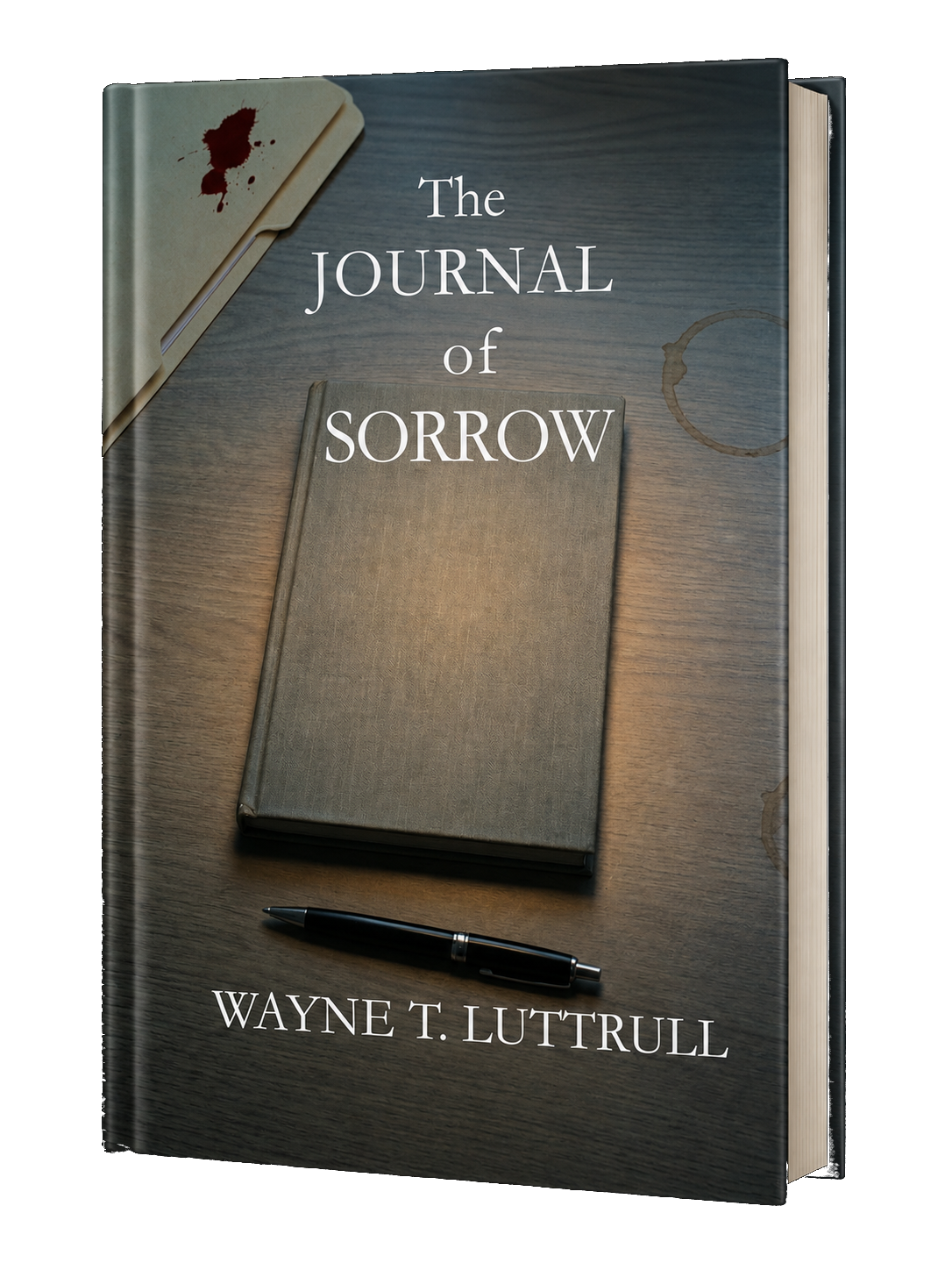
Opening chapter by Wayne T. Luttrull.
Read this newly edited sample. The Journal of Sorrow is planned for release at the end of 2026.
Read the Opening Chapter
The office was silent differently during winter.
A silence with weight. It pressed against the laminated windows from the inside, in one direction only. Steady as a current.
Travis arrived at work before anyone else.
Holy Meadows sat on the southern edge of Bozeman, Montana, where the pines thickened and the residents thinned. Built in the 1940s as a tuberculosis ward, it still had the long wings and high ceilings from that era. Views of nothing that mattered. The original brick ran along the foundation, scrubbed pale over the decades, never quite white.
His office had been carved out of the old staff quarters. The carpet was newer than everything else, but still predated Travis by a decade. Ivory paint covered the walls but couldn't smooth the plaster underneath; old lines still showed through the new. Two windows, sealed shut. Cold at the edges. Travis had stopped explaining to visitors that the difference was control, not weathering.
One diploma hung crooked in the row on the far wall, three degrees off true, and had sat that way since his first morning. He'd decided once not to fix it. He opted to decide nothing about the matter since. The tilt was part of the room, alongside the old radiator and dated carpet.
Travis worked in layers. The laptop held the official documentation. The monitor ran his session notes and timestamps. The trackpad, next to it, logged everything else. A smart pen sat clipped to the edge, turning his handwriting into text while he kept his eyes on the patient. Shorthand he'd read back later, half of it looping past legibility. A recorder he might use for a complex presentation.
The only clinical paperwork allowed in the room was the current case file. Holy Meadows still kept paper charts. Everywhere else had gone digital years ago. Travis never found the duplication comforting.
A personal notebook sometimes sat open on the desk that Holy Meadows permitted its psychiatrists to use. Ideas Travis hadn't sorted yet went in there. Fragments. Half-formed lists. A line that appeared without context, requiring a place to settle before vanishing.
Travis took one more look over his desk to complete his morning routine. Phone screen, then DSM-5, then stylus. He checked the recorder's charge, opened a blank Word document, and poised the stylus mid-sentence. To anyone watching, it might have looked like a distraction. Procrastination at its most efficient level. Travis disagreed and needed the process to ground himself for the day.
This Monday, the room's quiet possessed an unusual form. One that Travis could not smooth with his normal daily rituals.
—
A knock sounded at ten o'clock.
His next appointment. A new intake. The worst way to start a Monday.
The door's hinge protested; the wood moving slower than usual, as it consistently did in the winter. A nurse Travis did not recognize stepped halfway through the frame, holding the edge. Jacob Eldrin came in behind her. Not sluggish. Not resistant either. His movement was hard to categorize.
"Thank you," Travis said.
The nurse nodded and stepped back out. The door returned to its frame.
Jacob stood where he'd stopped. His gaze landed just left of Travis's face, not on it, the way it would if someone was standing a half-step behind him.
Travis gestured to the chair.
Jacob sat. His fingers stayed laced together, like hands that had forgotten what they were for.
The two remained silent while the ambiance of the morning took over. The tick of his wall clock. The radiator's one remembered click. Somewhere past the door, a medication cart squeaked on one wheel. The east wing curved around the office block like a question mark. Three doors down was the containment suite, soundproofed. Past that, the intake ward, the nurse's station, the corridor to the patient garden. Closed since August.
Travis had walked the grounds once at dusk. The pines around Holy Meadows didn't belong to any landscaping plan. They'd been there before the building, and no one had ever cleared them. No birds nested in them. Bark cold under his palm. Some evenings it felt like the building was pushing outward against the treeline, staking a perimeter the trees barely tolerated.
Travis unsealed the case file, advanced two pages, then backwards one. Not superstition. A habit that gave the noise in his head somewhere to sit while he worked. He tapped the folder's corner twice and set it down.
He picked up the smart pen.
—
"I'm Dr. Winston. You can call me Travis if that's easier." He shifted his weight, not toward Jacob, nor away from him either. "This is an intake interview. Structured, based on what you wrote this morning. Some of it will overlap with your first intake, but I need my own baseline. There's no right or wrong answer here. If you need to stop, say so."
He turned the pen once around his thumb and wrote:
Flat affect. Eye contact inconsistent, gaze displaced left.
Jacob's gaze shifted as Travis spoke.
"Start wherever it makes sense to you," Travis said.
Jacob's voice came from somewhere he'd been holding it too long.
"Started with a package." He held his hands motionless in his lap. "I ordered nothing. The box was just there on the doorstep. Brown paper, no return address, my name printed on the label in a font I didn't know. Print, not handwriting. The kind that makes something look official." He glanced down at his hands. "I brought the box inside."
Travis wrote:
Onset: object received. No prior history given. Passive framing.
"Inside was a journal," Jacob said. "Blank every page. I went through it once, holding the pages up to the light. Nothing there. I set it on my desk and went to bed."
He paused briefly.
"That night I felt it," Jacob said. "Like something left running in another room, the kind you can't place but you know is on." He glanced toward the window, then toward his hands. "I got up and went back to the desk. I opened it again."
Travis kept the stylus above the pad.
"In that instance, there was writing in it."
Re-approach, compelled. Content appeared between the first and second inspection. No mechanism given.
"What did it say?" Travis asked.
"A story." Jacob's fingers curled and let go. "Someone else's life, written first person, past tense. Specific. Detailed. It read like a record, not a story. It did not feel like fiction. All handwritten with fresh ink that smeared when I touched it." His jaw worked once. "I read it fully and went back to sleep."
"And the next morning?"
"New pages," Jacob said. "A second life. Same format, different person, a new Roman numeral at the top. The page sat there as if it had always been in the book. No seam at the spine, no different paper. Words magically arrived." He glanced toward the desk, then away. "By the third morning, I was waiting for the next one before I knew I was even awake."
Travis wrote without looking down.
Content delivered in sequence. Format fixed: numeral, first person, suffering as endpoint. Anticipatory behavior by day three. No distress language used.
"Had you been writing them yourself?" Travis asked.
Jacob faced him squarely for the first time.
"I write," he said. "I've written my whole life, my own fiction, my own notebooks, in my own hand. The entries knew that about me. Used it. I feel. The third one had my cadence, the way I build a thought and turn a scene. The journal had pulled that from somewhere with no right to reach in."
Content matched to the subject's known creative habits. Framed as extraction, not inspiration.
Travis kept his voice level. "What do the entries show you?"
Jacob pressed his lips together. He felt less fear, more indecision regarding his words.
"Lives," he said. "Different people, places, times. But they all move in the same direction. Toward suffering. Toward the worst moment a person can have, and I feel that moment from inside their perspective."
Jacob's hand became motionless on the armrest.
No identity fracture. Not delusion in the usual shape. Closer to something like inherited grief, except the source sits outside him and keeps escalating.
"Tell me about the handwriting," Travis said.
"The first few entries, the handwriting wasn't mine," Jacob said. "Close. Right proportions, right letterforms, but the pressure was wrong. Too even. Like someone tracing a sample instead of writing from memory." He flipped his hands in his lap. "By the sixth entry, it was mine. All the way. The pressure I put on an upstroke, the way I close a lowercase g. Details nobody could fake unless they'd been inside the act of me writing it." He stopped. "The time-"
He didn't finish the sentence.
"Time?" Travis asked.
"The time I wasn't there for." Jacob said. "I'd open the book. Start reading. When I finished, I'd be holding a pen with wet ink on the nib and the entry done, in my own hand. Nothing in between. No sense of writing, no memory of the minutes passing." He met Travis's eyes. "Like watching a film where the script gets written the same moment it's playing. The film is already up on the screen. Then the credits roll and I'm the one holding the camera."
Memory gaps around reading episodes, no confabulation, no retrospective filling in. Pen found in hand after each gap. Consistent with automatism or with the object account he's giving. Not coding either way yet.
Travis tightened his grip on the smart pen.
"They never believe me," Jacob said. Quieter. Under his breath.
"Who doesn't believe you?"
"Everyone."
No flinch on his face.
"I showed my sister," Jacob said. "Waited until the tenth entry." Travis logged the timing. Jacob's eyes stayed on him. "She looked right at the open book and told me the pages were blank."
Travis opened the file, not to read it, just to give his eyes somewhere neutral to rest.
Outside observers report blank pages. Sister, primary contact. Content present for the subject, absent for the observer.
"Did she see anything at all? Headers? Partial lines? A doodle or two?"
"Nothing," Jacob said. "She held it up to the window. Went through every page. Looked at me the way people look at you once they've decided you're sick." He paused. "She set the book down with a look of fear and worry." Another pause. "After that, she started watching me more closely."
His hands went back to his lap.
"That was the first time I understood what the journal was," he said. "Not what was written on the pages. What the object itself was. Not a book you carry around. A thing that picks its own readers." His gaze wandered to the bookshelf, not focusing on any one item there. "My sister held the same page I did. The words showed up for me and didn't for her. Not hidden from her. Just never there. A frequency you get or you don't. I stopped showing anyone after that."
Content confirmed reader-specific by a negative outside witness. He does not define this as a symptom. He's framing it as a hypothesis.
"Have you tried documenting it in any other way? Say, a photograph or a video?"
Jacob's head didn't move. "I filmed the pages. Blank on every frame. Photographed it too, same result." He gripped the armrest once. "Checked the angle, the light, camera sensor against my eye. Every variable I could think of." His voice remained level, but it was the levelness of someone who'd already run through every choice and watched all of them come back empty. "Then I went to a park. Public wildlife cameras, archived footage, have been running for years on a bald eagle's nest. I sat on a bench inside its range and read an entry."
Travis's pen stopped. "I know that park. Lovely place."
"It used to be. That night I pulled the footage," Jacob said. "Timestamp matched when I'd been sitting there. I watched the whole clip." A pause sustained for the precise duration required. "Showed me on the bench. Watching people go by. No book in my hands."
Independent third-party footage, public cameras, archived, outside his control. Shows him separate from the object during a window he says he was reading. This part is checkable. Flagging it.
Somewhere underneath, the gap between what Jacob had said and what the log would eventually show got set aside. Pending discussion for a future session.
"Did you ever try to dispose of the journal?" Travis said.
Jacob's knuckles went pale on the armrest.
"I'd tried in the beginning. I tried to burn it, but it only fanned the flames. I even tore it apart another time and ran it through a shredder. The next morning it was back on my doorstep. Same stories, fresh paper, no scorch marks, no smell, no torn edges. Whole again, like it never left." His vision darted from desk, radiator, back to his own hands. "I gave up trying after the sixth story.
Object returns intact after supposed destruction. He describes it as operating on its own terms, not on his.
Open question: a single object moving between obliteration and retrieval, or multiple copies originating from one provider.
"Tell me about the writing you mentioned before all this," Travis said. "Your own fiction, your notebooks."
"I wrote all the time, as I said," Jacob said. "That work was mine, no doubt in my mind. This isn't my work. Something used me while I read, taking what was in my head to build the next page. My handwriting and, in later entries, my unique prose too. By the end, the journal knew how to mimic me." Something in him seemed to close for a second. "I couldn't find the line of my own." He stared at Travis. The eye contact on this occasion was deliberate. "But this isn't me. I need you to know that."
'It knows how to sound like me': Patient describes not being possessed by the object, instead they feel they are being 'used' and mimicked. Further reflection is scheduled for future sessions.
"Has it ever told you to hurt yourself? Or anyone else?"
Jacob peered at the floor as if he were reading something off it.
"No. Never tells me to do anything. Shows the suffering of others but not me. What happens to the people inside those pages." He lifted his eyes. "How each one of them ends. Bearing witness to the sorrow is my punishment."
"The stories inside feel as if they were done to real people? Any names you recognize or locations within them?"
Jacob didn't answer.
The radiator gave a sharp click. Jacob turned toward it. His face changed.
"Jacob," Travis said. "What brought you to Holy Meadows? The stories inside the journal?"
Jacob rubbed the back of his neck.
"I am here because the journal stopped coming back," he said. His voice had thinned. "After the twelfth entry, I waited for the thirteenth. Kept a space clear on the desk. Slept with the light on the first week. By the second week, I thought of nothing else. There was no thirteenth and still isn't one."
"How long ago was that?"
"A month was the last time I had possession of the journal."
"Could it have possibly ended? The stories are completed, and therefore there is no need for you to read more?"
"The twelfth story wasn't finished like the others were. Felt to me it had no ending, a thread left hanging." He pressed two fingers to the inside of his wrist. His shoulders drew in. "I kept waiting for the next one. When it didn't come, I understood what that meant. Whatever the ending was, it wasn't for me. I stopped sleeping right, stopped eating on any schedule. My sister said I was having a break and talked me into checking myself into this ward."
Sudden onset, twelve entries across twelve days, then an abrupt stop with no resolution. Withdrawal symptoms afterward. Fixated on the missing thirteenth.
"And you agreed that easily?" Travis asked.
"Not at first. The night before I decided I would check myself in, I had a dream," Jacob said, no weight added to the word. "The journal was here. Not at my apartment. Here, at this building. And the thirteenth entry was written inside." His attention drifted over the bookshelf, the reference texts, the case manuals.
Dream involves the object relocating to this facility, with the missing entry completed. Could be prophecy or wish fulfillment tied to the dream.
Travis maintained a motionless expression.
"Do you think it'll find you here?"
Jacob met his eyes. No hesitation this time.
"I think this is the thing it won't put up with," he said. "It doesn't tolerate the spotlight."
—
The hallway buzzer sounded. Shift change. The clock resumed its standard ticking after an hour that had blurred and compressed. A second buzzer went off, farther away, east wing. Travis glanced at the wall clock and closed the file.
"That's enough for today," Travis said. "The nurse will get you scheduled for your first regular session."
Jacob nodded, his hand touching the knob while he stood near the entrance.
"I felt something. Sitting at your desk just now," he said.
"What did you feel?"
"That you're going to read it, Dr. Winston."
Travis let a moment pass before answering. "I'd need the journal for that."
"Don't read it all at once."
Travis stayed where he was, behind the desk.
"I appreciate you telling me all this, Jacob. You will be the first to know if the journal shows up in my office."
Jacob didn't answer. He observed Travis for another moment, his hand still resting on the knob.
"Don't fight the pull," he said. "If it finds you. Don't fight the pull to read."
Jacob opened the door, stepped into the hallway where a nurse waited near the wall, then vanished, his form diminishing along the corridor.
Travis leaned back as silence flooded the room. He tapped the corner of the case file twice and set it down.
He glanced at the wall clock. The second hand was moving at normal speed.
End of intake. Reviewing clinician: T. Winston, Ph.D. Audio log active. Physical chart secured. Recommendation: Continued weekly sessions focused on understanding the connection between the patient and the mysterious journal.
Continue the Case
The Journal of Sorrow releases at the end of 2026. Join the waiting list for a free copy and hear when copies are ready.
The story also connects to The Journal of Sorrow: The Lost Entries, a psychological horror game in development at Ice-Type Platypi Studios.